PGA Championship Is Here
By Colton Peters · May 14, 2026
We are so back
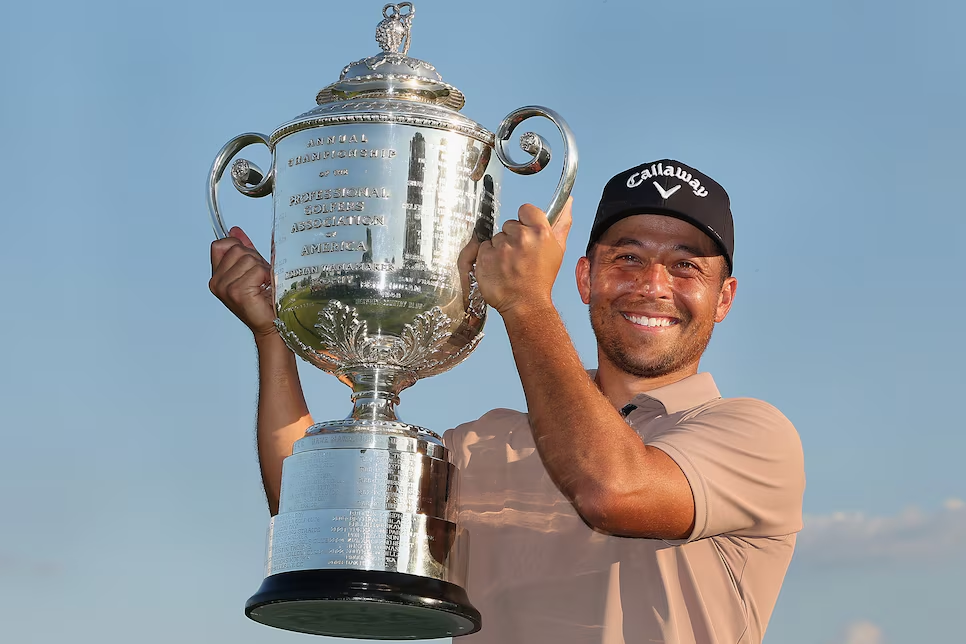
The History of the Wanamaker
Before we get into the course and the picks, let me give you some context on what this tournament actually is because it does not always get the respect the other three majors get and it absolutely should.The PGA Championship started in 1916. A New York department store magnate named Rodman Wanamaker gathered 35 people in a room, including Walter Hagen and Francis Ouimet, and laid out his vision for what professional golf in America could become. The following month the PGA of America was formed. Later that same year the first championship was played at Siwanoy Country Club in Bronxville, New York, and a Cornishman named Jim Barnes took home $500 and a diamond-studded medal that Wanamaker himself had contributed. He also took home the trophy that still bears Wanamaker's name today and weighs 27 pounds when a champion hoists it.The tournament ran as a match play event from 1916 through 1957. Some of those final years featured finalists who had played over 200 holes in a single week. When television networks came knocking and said they wanted to see the world's best players on screen at the same time, the PGA switched to stroke play in 1958 and never looked back.The record books on this one are stacked. Walter Hagen won five times in the match play era including four consecutive from 1924 through 1927. Jack Nicklaus won five in the stroke play era making them the joint record holders with five each. Tiger Woods won four. Brooks Koepka, Sam Snead, and Gene Sarazen each have three. Phil Mickelson became the oldest major champion in history when he won at Kiawah Island in 2021 at 50 years, 11 months, and 7 days. That record still stands.The Wanamaker Trophy itself is one of the great objects in sport. Heavy, ornate, and massive. The champion gets to keep it for the year before returning it. The name on it this week is Scottie Scheffler, who won at Quail Hollow last year by five shots over Harris English, Bryson DeChambeau, and Davis Riley. He is coming back to defend at a venue he has never seen before.
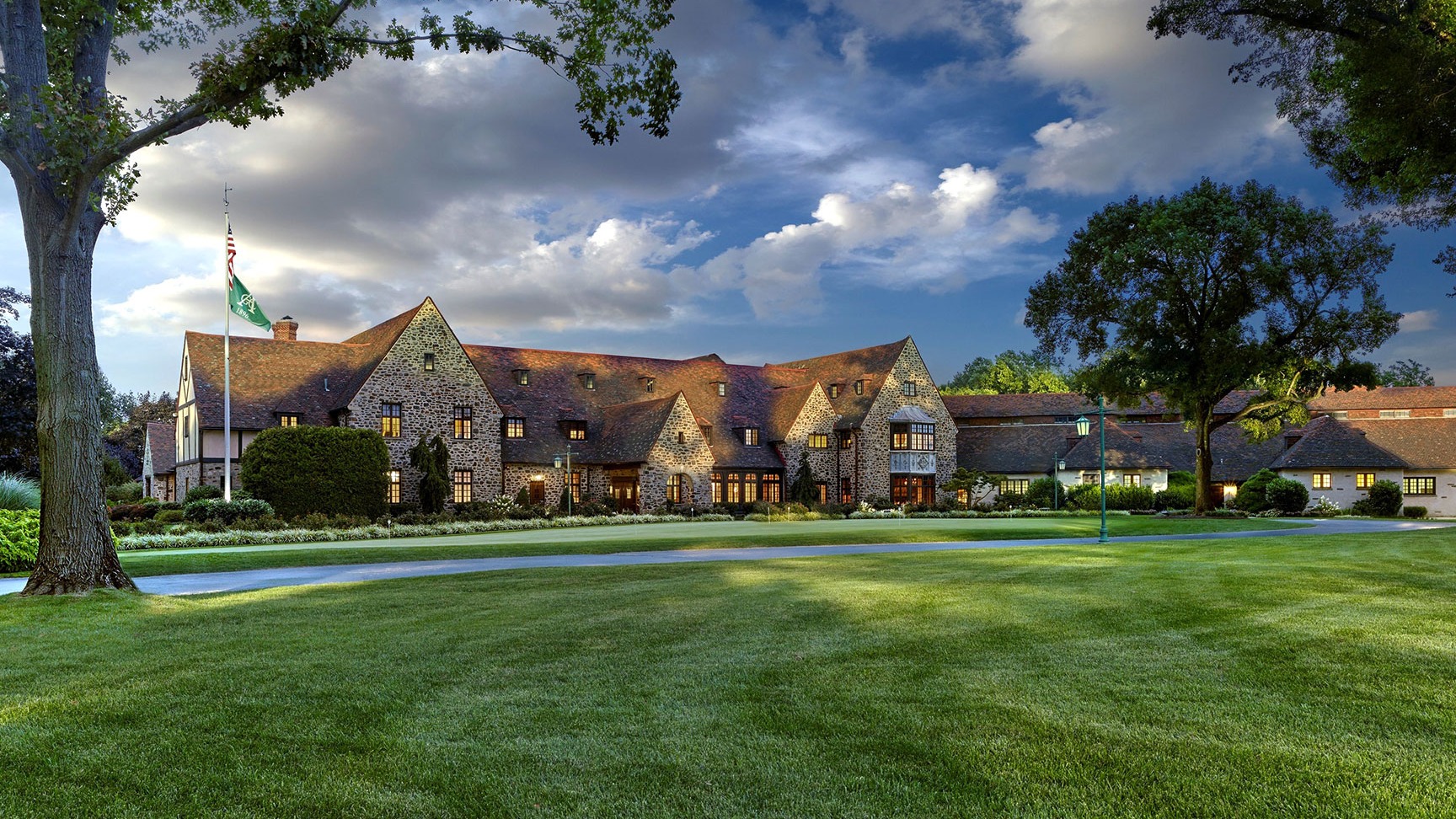
Aronimink Golf Club — The Course You Need to Understand
Donald Ross said something about Aronimink in 1948, twenty years after he designed it. He said he intended to make it his masterpiece, but that he did not realize until that day that he had built better than he knew.
That quote is engraved on a plaque behind the first tee. It is the most understated flex in the history of golf course design.
Ross was a Scotsman who arrived in America in the early 1900s and proceeded to design some of the finest golf courses on the continent. Pinehurst. Seminole. Oak Hill. Oakland Hills. Scioto. And then Aronimink, which he considered the best of all of them. The club moved to its current 300-acre site in Newtown Square in 1926 and Ross completed the layout in 1928. The course opened and it has been testing the best players in the world ever since.
The design principles Ross used at Aronimink are rooted in the linksland golf of his native Scotland. He believed the lay of the land should affect the ball being played. Not in a punishing way but in a strategic way. Every shot at Aronimink requires a decision. Where do you miss the green? Which side of the fairway do you want? How do you use the slope? The course is never unfair but it never stops asking questions.
The stat that tells you everything about what you are in for this week is this. There are 75 bunkers on the property. The most intensively bunkered hole is the par-four eleventh where more than 20 of them guard the fairway and circle the green. The green on eleven is also the most severely sloped on a course full of severely sloped greens. Miss it above the flag and you are looking at three putts minimum, if not worse.
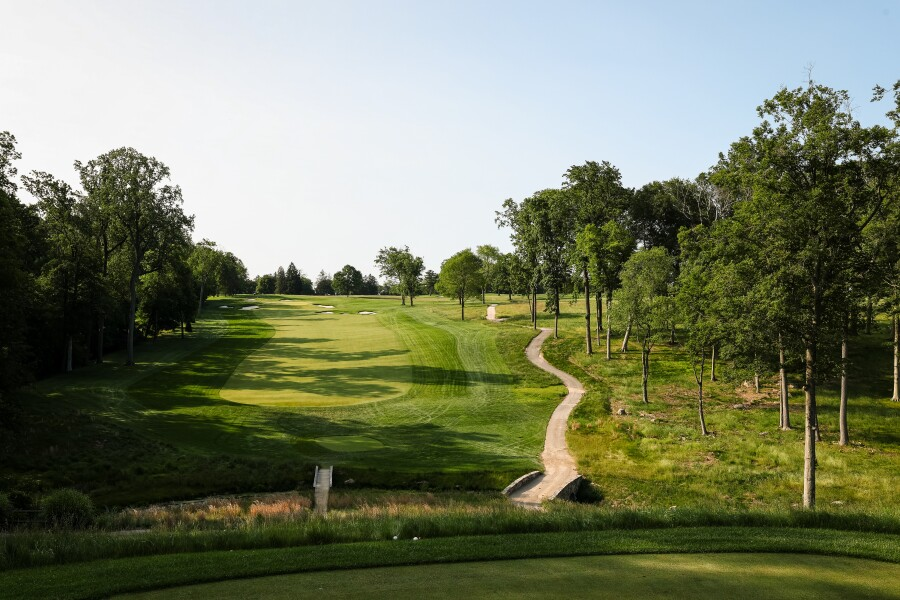
The course plays to par 70 this week at just over 7,300 yards. Not the longest championship setup you will see but par 70 with Aronimink's green complexes is not a number that is going to get beaten up. The opening hole sets the tone immediately. A downhill tee shot from below the clubhouse followed by an uphill approach to a semi-blind green with deep bunkers left and right. The only hole on the property with defined upper and lower tiers. A Ross specialty he used to wake players up before they settle in. It is, as Golf Digest noted, far from a gentle handshake.
The 18th got longer for this championship. A new tee box was added in 2025 that stretches the closing par four to 490 yards, putting it in the same conversation as the famous finishers at Merion and Oakmont. Uphill, bunkered, with a winding sloped green that offers multiple nightmare pin locations. The champion this week will have to make something happen on that hole at some point. You can count on it.
A meticulous restoration by Gil Hanse and Jim Wagner, completed in preparation for major championship golf returning here, brought the course back to what Ross actually intended. More than 100 bunkers were added or restored based on 1929 aerial photographs. Fairways were widened to original dimensions. Greens were returned to their original perimeters. The result is Aronimink as Ross imagined it, not as decades of well-meaning but misguided alterations had left it. It is ranked among the top 100 courses in America and Golf Digest has placed it at number eight on their Platinum Clubs list for 2025 through 2026.
What Happened the Last Time the PGA was Here
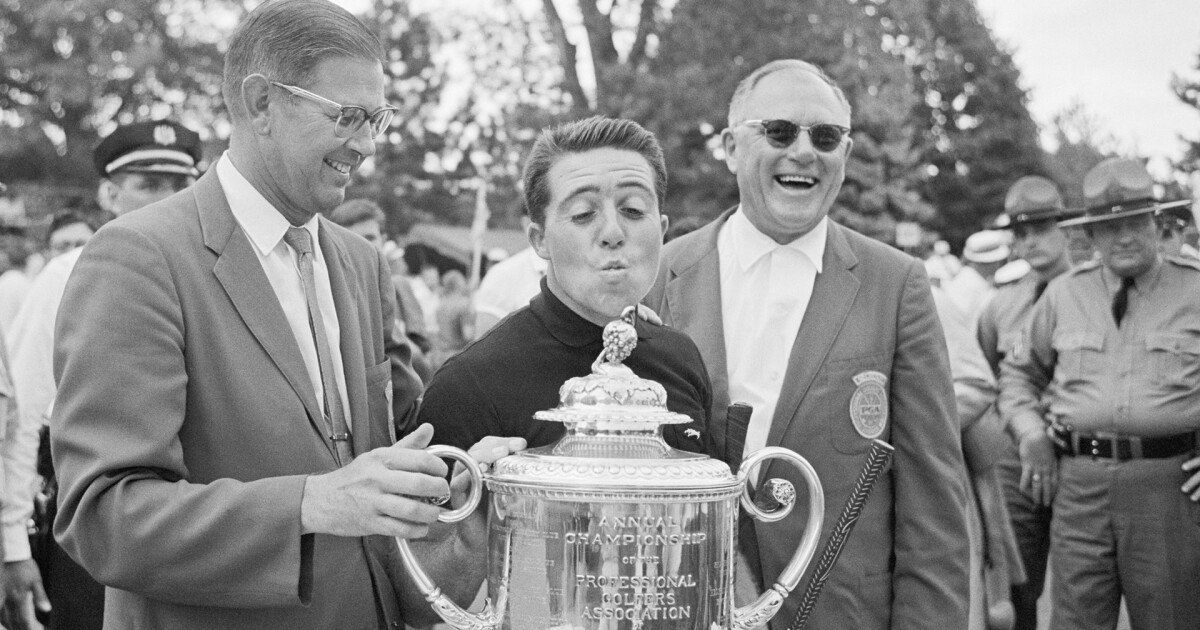
In 1962, Gary Player arrived at Aronimink having just missed the cut at the Open Championship at Royal Troon the week before. He told the story later that he hit his approach one inch over the green on the final hole, out of bounds, and missed the cut. He got straight on a plane to Philadelphia, spent the week before the PGA talking with the Aronimink membership and working out the kinks in his game on the practice ground.
He opened with a 72, two over par, and was behind the proverbial eight ball. He grinded through the week and held off a late charge from Bob Goalby to win by a single shot, finishing at two under par for the championship. That victory was the third leg of Player's career Grand Slam. He was 26 years old.
The significance of that moment to the tournament this week is not lost on anyone paying attention. Player completed his Grand Slam at Aronimink in 1962. Rory McIlroy completed his Grand Slam at Augusta last month. He is now at Aronimink trying to become the first player since 1975 to win both the Masters and the PGA Championship in the same calendar year. History at this course has a way of connecting itself across generations.
The most recent major championship experience Aronimink had before this week was the 2018 BMW Championship, a PGA Tour playoff event rather than a major, won by Keegan Bradley in what was described as a putting performance that had no precedent in his surrounding results. The important detail from that week, noted by ESPN's betting analysts, is that the course activated certain abilities rather than simply rewarding players who were in form. Rory McIlroy had the best ball striking of anyone in the field that week and finished fifth. The player who putted best on those Aronimink bent grass greens won the tournament.
That is useful information going into this week.
The Profile That Wins at Aronimink
This is a precision golf course. Not a power golf course. The distinction matters enormously for how you approach the betting market and how you think about who is going to win.
Ross designed Aronimink to be the supreme test of long iron play. His words, not mine. The opening hole makes that clear from the first swing of the week. The approach shots here are demanding, the green complexes are severe, and the player who hits long irons and mid irons with precision and trajectory control is going to have a massive advantage over the player who can only play well when he is hitting wedges and short irons.
The bent grass greens are the other key factor. Aronimink's greens will roll faster than anything in the field has seen in a while. The slopes and tiers mean that putting from the wrong position is essentially a two-putt minimum wherever you are. Players who have demonstrated strong performance on bent grass greens at major championship speeds have a real edge here. That filters the contender list meaningfully.
Fairways gained is also a premium this week in a way it is not always at PGA Tour stops. The bunker count is 75. They are everywhere. They guard fairways, they surround greens, they penalize misses that would be manageable at other venues. You do not have to be the longest driver in the field to win here but you absolutely have to be in the fairway. Any player whose primary strategy relies on recovering from rough is going to struggle.
The course also rewards patience in a way that Augusta does. There are scoring opportunities built into the layout but they require setup. The par fives are reachable but the approaches are demanding. The short par fours invite aggression but punish anything loose. The player who manages his emotions across four rounds, takes what the course gives him, and is still standing with opportunities on Sunday afternoon is going to win this tournament.
The Contenders, the Picks, and the Bets
Here is the field you need to understand going into Thursday.
Scottie Scheffler is the favorite at plus 385 to plus 480 depending on where you are betting. He is the defending champion. He has finished in the top seven in each of his last six major starts. He has been runner up three consecutive times coming into this week and looks like he is getting hot at exactly the right moment. The concern with Scheffler this week is that he has never played Aronimink before and the course rewards local knowledge and feel in a way that penalizes players who are figuring it out on the fly. His ball striking metrics are still elite but they have not been at the otherworldly 2025 level he was operating at last year. Plus 385 is a lot of chalk to lay on a guy seeing a course for the first time.
Rory McIlroy is second on the board at around plus 900 and comes in with a fascinating storyline. Two consecutive Masters wins. Six major championships. A chance to win both majors played so far this year for the first time anyone has done it since 1975. There is also a reported blister on his toe that has him less than a hundred percent, which explains why his odds have drifted out from plus 650 to close to plus 1000 in the days before the tournament. You either love or hate Rory by now and I have made my position clear in previous issues. But the ball striking when he is healthy at a venue that rewards it is difficult to argue with.
Cameron Young is the pick I keep coming back to. He is sitting at plus 1200 to plus 1500 depending on the book and represents the best value at the top of the board. He is the hottest player in golf right now. He won The Players Championship. He finished tied for third at the Masters. He was right there at the Zurich Classic. His dad is a PGA club professional, which is literally the foundation of this tournament. He is long off the tee and has been one of the best putters on tour this year. The knock on Young at majors has always been that he has not broken through yet, but at some point the near misses become the actual win and you want to be on board before it happens.
Matt Fitzpatrick at plus 2200 deserves serious consideration from anyone who has been paying attention this year. Three wins in five starts. Ranked fifth on tour in approach play. Gained strokes around the greens in eight consecutive starts. The precision shotmaking that Aronimink demands is exactly what Fitzpatrick does better than almost anyone in the world right now. His one major is the 2022 US Open, a precision golf course that rewarded exactly the same skill set. He is the most in-form player in the world and the market has not fully caught up to that reality yet.
Tommy Fleetwood at plus 2500 to plus 2700 is the name I want on a top-ten bet more than any other player in the field. He played at Aronimink for the BMW Championship in 2018 and finished second. He has the calm demeanor and the elite iron play that fits this venue perfectly. His putting has been the question mark this year but Aronimink's bent grass greens are the surface where he has historically been at his best. He has been knocking on the major door for years and the combination of course fit and current form makes this week feel like it could finally be his time.
Justin Rose at plus 4500 to plus 5500 is the value play I cannot stop thinking about. He has been one of the most consistent players in the world in 2026. He nearly won the Masters. He is ranked seventh in the world. The approach play and short game combination at major championship venues is as good as anyone's in the field when he is engaged. The 2018 BMW Championship at Aronimink saw him finish second despite losing strokes on approach because he scrambled and short-gamed his way around the course. When Rose is locked in at a venue that suits him you are getting a world class player at odds that do not reflect his current level.
The number to beat this week is somewhere around ten to twelve under par. The course is firm, the restoration has added teeth to a layout that already had plenty, and the greens are going to be running at Augusta-level speed. This is not a birdie-fest. It is a survival test dressed up as a major championship and the player who combines precision iron play, bent grass putting, fairway accuracy, and composure over four rounds is going home with the Wanamaker.
It is going to be a hell of a week.